Carsten Höller (Brussels, 1961)
Carsten Höller is one of the contemporary artists who has most clearly placed the viewer’s experience at the centre of the work. Born in Brussels in 1961, he initially pursued a scientific career: he studied Agronomy and Biology at the University of Kiel and obtained his PhD in 1988 with research into the chemical communication of insects. He subsequently worked as a researcher in the field of biology before devoting himself fully to art in the early 1990s. His scientific background continues to be a fundamental reference in his practice, characterised by experimentation, observation and the questioning of our perception and behaviour.
His works explore situations in which the viewer becomes an active participant in the experience. Höller investigates how certain alterations of the senses, space or movement can modify our perception of reality. To this end, he works with installations, sculptures, architectural structures, games, lights, mirrors and devices designed to be used or experienced. His work combines the rigour of research with a playful dimension that invites us to question what we normally take for granted.
From his earliest participatory installations, the artist has developed a practice in which perception, uncertainty and bodily experience occupy a central place. Among his best-known works is Test Site (2006), created for the Turbine Hall at Tate Modern in London. The installation consisted of five large slides that crossed different levels of the building, allowing visitors to physically move through the museum space. The work transformed the architecture of Tate into a place of experience and play and became one of the most memorable interventions in the history of the Turbine Hall.
Other important works in his career include Flying Machine (1996), which allowed visitors to experience the sensation of flying through a system of harnesses; Upside Down Mushroom Room (2000), an installation of large inverted mushrooms that alters the perception of space; and The Double Club (2008–2009), a project developed in London that combined a restaurant, bar and nightclub, bringing together elements of Congolese and Western cultures.
Throughout his career, Höller has developed projects at some of the world’s leading museums and international institutions, including Tate Modern, London; Fondazione Prada, Milan; Centre Pompidou, Paris; MASS MoCA, Massachusetts; ICA Boston; New Museum, New York; Hayward Gallery, London; National Gallery of Victoria, Melbourne; Museo Tamayo, Mexico City; MAAT, Lisbon; and Pirelli HangarBicocca, Milan. He has also participated in major international exhibitions, consolidating a practice situated at the intersection of art, science, architecture and experience.
His work is held in important international collections, including Tate, London; Centre Pompidou, Paris; Fondazione Prada, Milan; Musée d’Art Contemporain de Marseille; Museum für Moderne Kunst, Frankfurt; Bonniers Konsthall, Stockholm; 21st Century Museum of Contemporary Art, Kanazawa; Victor Pinchuk Foundation, Kyiv; McEvoy Foundation for the Arts, San Francisco; and ZKM | Center for Art and Media Karlsruhe, among others.
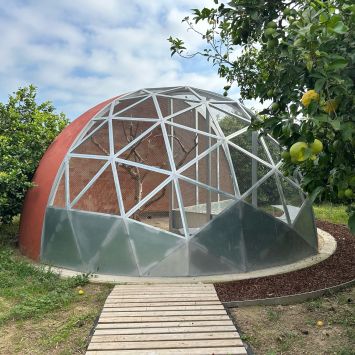
At Todolí Citrus Fundació, Höller has brought some of these concerns into a context where art, nature and scientific observation meet in a particularly direct way. Aviario Todolí Citrus is a functional sculpture conceived specifically for the Foundation and integrated among the rows of the El Bartolí Botanical Garden. Its hemispherical structure, inspired by a citrus fruit, establishes a direct relationship with the agricultural landscape surrounding it and with the Foundation’s living collection of nearly 500 citrus varieties.
The work also incorporates another significant aspect of Höller’s practice: his interest in songbirds. His background as a biologist and his knowledge of animal behaviour find a unique context at El Bartolí. The aviary is intended to house bird species traditionally associated with Valencian citrus orchards, incorporating birdsong, movement and the presence of the animals into the work. In this way, the sculpture does not simply occupy the landscape but incorporates living and sonic elements that form part of the experience of the work.