Pancrace Bessa (París, 1772 – Écouen, 1846)
Pancrace Bessa was one of the most distinguished painters and illustrators of natural history in France during the first half of the nineteenth century. Specialising in flowers, fruit and, occasionally, birds, he developed a remarkably precise style of painting in which descriptive rigour is combined with a delicate sense of colour and composition.
He trained in the circle of the Muséum national d’Histoire naturelle in Paris—then one of Europe’s leading centres for the study of the natural sciences—where he came under the influence of Gérard van Spaendonck and Pierre-Joseph Redouté. From both artists, he inherited a meticulous attention to plant structure, the transparency of watercolour, and the use of vellum as a privileged support for botanical representation. Between 1806 and 1831, he exhibited regularly at the Paris Salon.
His work was closely connected with the leading scientific, horticultural and agricultural publications of his time. Among other projects, he contributed to Étienne Ventenat’s Choix de plantes, Aimé Bonpland’s Description des plantes rares cultivées à Malmaison et à Navarre, and the illustration of François-André Michaux’s Histoire des arbres forestiers de l’Amérique septentrionale. His original works were often reproduced as stipple engravings, allowing his images to circulate widely among botanists, collectors and horticultural enthusiasts.
An essential part of his career was linked to the Duchess of Berry, Marie-Caroline of Bourbon-Two Sicilies. From 1816, he enjoyed her patronage as a flower painter and later became her drawing master. For L’Herbier général de l’amateur, Bessa produced 572 watercolours between 1810 and 1826; in 1826, Charles X gave the group to the Duchess of Berry as a New Year’s gift.
In 1823, Bessa succeeded Henri-Joseph Redouté as painter at the Muséum and worked for the Vélins du Roi, the historic collection of watercolours on vellum begun in the seventeenth century. In this context, his works were not merely decorative images: they responded to the need to record species, varieties, plant structures and horticultural novelties with a precision useful for research. Bessa thus helped to establish a visual language in which art and science reinforce one another.
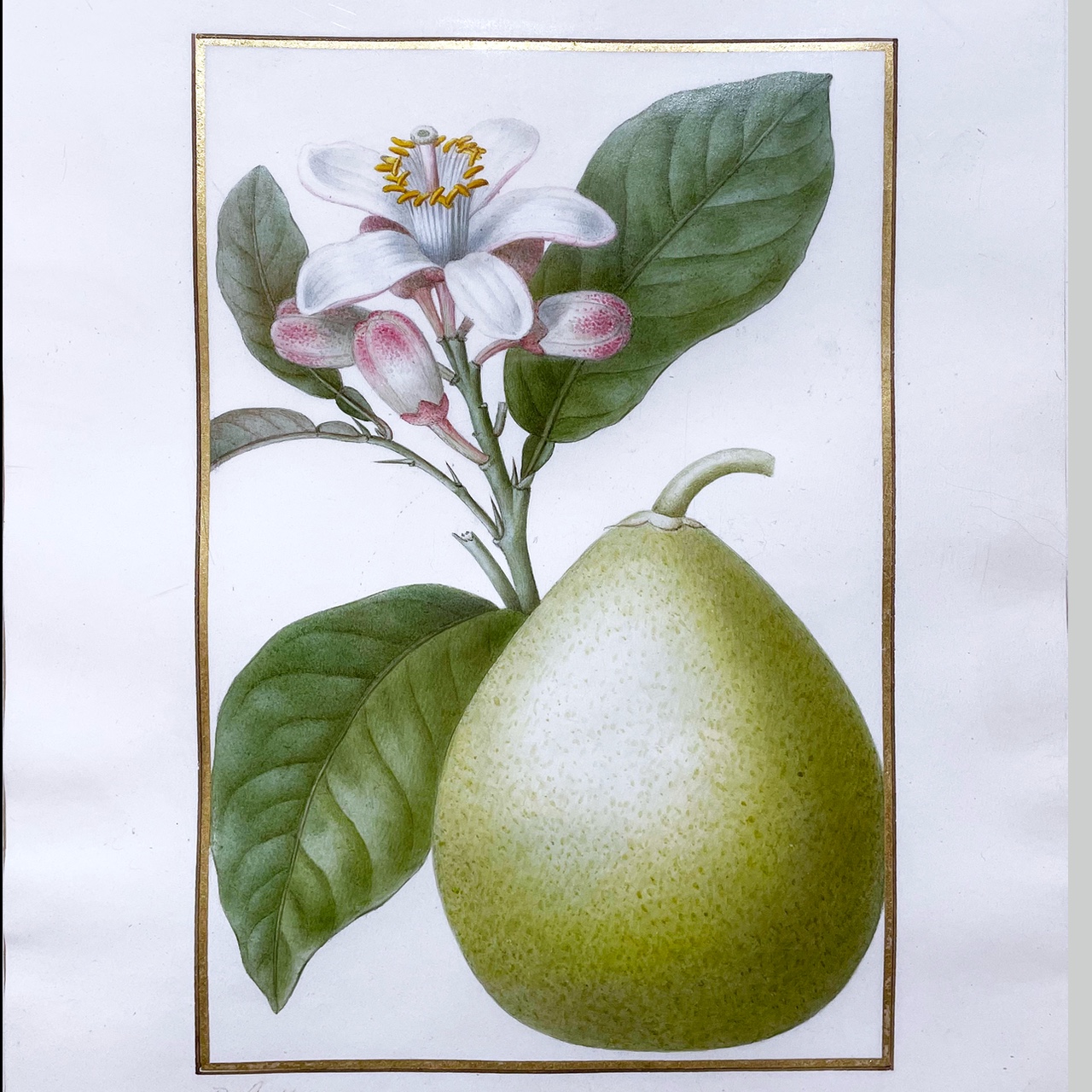
His highly refined output occupies an important place in the French tradition of botanical illustration. In his works devoted to fruit and citrus varieties, such as Lumie Poire du Commandeur, his close observation of form, skin, leaves, flowers and twigs transforms each composition into both a botanical document and a work of great pictorial elegance.
Note on Bessa’s portrait
Portrait attributed to Pancrace Bessa, probably 1844. Daguerreotype, quarter plate. The image comes from Pinterest, whose caption identifies the sitter as “Pancrace Bessa à 72 ans” and dates one of the portraits to 12 July 1844. Although reasonable efforts have been made to verify this information, it has not been possible to confirm the attribution through the original object or an institutional source. The image is therefore presented as a portrait attributed to Pancrace Bessa; the Foundation would welcome any information that may help to complete or correct this identification.